They offer you two hundred.
They already know better.
What it is, what it’s worth, and how not to lose money the day it changes hands.
Instant PDF · Yours in 60 seconds · 7-day money-back guarantee
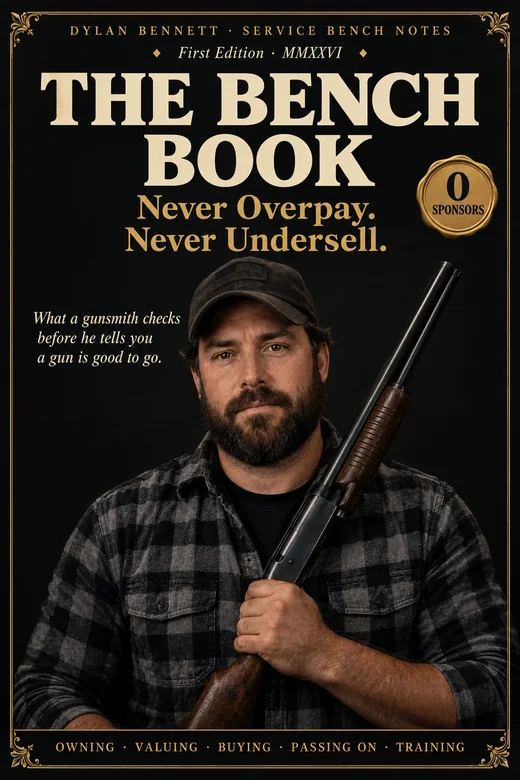
What it is, what it’s worth, and how not to lose money the day it changes hands.
Instant PDF · Yours in 60 seconds · 7-day money-back guarantee
Buy any one on its own
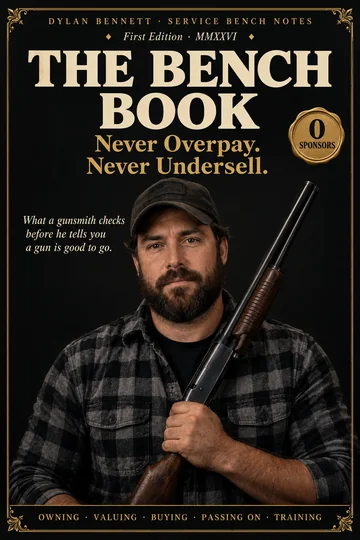
208 pages. What you own, what it is worth.
$39
Buy the book
Grades the gun, finds the real number, tells you if the price is fair.
$27
Buy the tool
Seven checks before you hand over cash.
$19
Buy the checklistBought separately the three cost $85.
All three together — $47
You save $38
Get all three — $47Instant download · 7-day refund
What actually goes wrong
Not fired them — looked at them. Taken them apart far enough to see the parts that decide whether they work, checked the things that wear, and written down what is there.
And it is about to get more common
470 million+privately owned firearms in this country. Millions change hands by inheritance over the coming decade.
The people receiving them are mostly not gun people — sons, daughters and nephews opening a safe for the first time, in a difficult week.
The list does not exist, so the family is guessing at a safe full of unfamiliar objects.
Which is how a valuable gun leaves for the price of an ordinary one — frequently to the first buyer who offers cash.
Inheritance rules vary by state, and interstate transfers have their own requirements.
Which gun was your father's. Which one should stay in the family. That information dies with the person who held it.
The full contents
Half of it is about what is already in your safe. Half is about buying without overpaying. The two tools are the same method, put in your hand to use at the counter. Open any part below and read the whole table of contents before you decide.
Chapter 3 teaches you the four prices. The Rip-Off Check runs them against what the gun really sold for, while you are still standing at the counter. That is the difference between reading it and using it.
Both included · nothing extra to payName every gun you own, price it against what guns actually sold for, and get it written down. The twenty-minute audit is Chapter 1.
The seven questions to ask, how to read the answers, and the four checks to run on a used gun before your money leaves your hand.
What the famous gun gets wrong, what the magazines will not print, and one chapter that argues against the rest of this book.
Inheriting. Selling down a collection. Downsizing. Crossing state lines. One chapter per week that actually happens to people.
A record sheet per gun. A counter card for your wallet. A service log, an annual routine, and Appendix K: every costly mistake, on one spread.
Every chapter title is listed below.
Instant download · 7-day refund
Chapter 3 · A worked valuation
A pump shotgun, twelve gauge, twenty-eight inch barrel with a ventilated rib. Finish worn silver at the muzzle and along the receiver edges. Brought in by a man who had been told it was worth about two hundred dollars.
Nobody lied to him. They priced a worn pump shotgun in eleven seconds, which is a reasonable thing to do. Here is what changed the number — three steps, fifteen minutes each, no tools and no cost.
The date code. The barrel carried a two-character code that put manufacture in the mid-1960s — before the manufacturing transition described in Appendix E. That single fact changed the entire conversation.
The variant. Two lines of this model existed. The checkering, the ventilated rib and the receiver finish all pointed at the higher grade.
Four sold comparables. Same model, same grade, comparable condition, within the previous six months. What they actually sold for — not what anybody was asking, which is a different and much less useful number.
Worth several times what he had been told — and not as a matter of opinion. Forty-five minutes separated those two numbers.
I am not going to put a number on what you will save, because I do not know what is in your safe and neither does anybody else selling you something. What I will say is that the book costs less than one bad afternoon at a counter, and that the mistake it is designed to prevent is the kind you only get to make once.
Who is telling you this

I run a service bench at a shop outside Springfield, Missouri. That means I do not see firearms the way most people writing about them do.
Not on a folding table under studio lights, with ammunition somebody sent me free. I see them afterwards. After eight thousand rounds. After a summer in a truck console. After twenty years in a closet. After a man’s widow brings in a safe’s worth of things nobody ever wrote down.
Fifteen years of that, and the patterns are impossible to miss. This book is those patterns. Nobody paid for a page of it.
“Nobody pays me to name a product in these pages, which is precisely why I can afford to tell you when the famous one is the wrong one.” Dylan Bennett · Introduction
What $47 buys
The manual, plus two working tools that put its checks in your hand — so you can run them standing at the counter, on your own guns, the same afternoon. Each one is sold on its own. Together they cost less than the book and one tool bought separately.
Bought on their own
It is cheaper together because the tools were built out of the book. Selling them apart is the exception, not the offer.
Instant download · 7-day refund
The guarantee
Take a week with it. Run the twenty-minute audit in Chapter 1 on your own guns, and the four inspection routines in Chapter 11 on whatever is in the safe.
If it does not tell you something about your own firearms that you did not already know, email me inside seven days and I will refund you in full. You keep the book. I would rather have that than your $47.
Get the book & tools — $47Instant download · 7-day refund
Being straight with you
Four things it does not do. I would rather you knew now than found out at page ninety.
Straight answers
Both, and they read it differently. A newer owner will start at Chapter 1 and work forward. Somebody with forty years in will more likely open Part Two at the used rack, or go straight to Chapter 6 about passing things on. Every chapter opens with the decision it helps you make, so you can start anywhere. Nothing assumes you already know the vocabulary — Appendix G explains all of it in plain English.
Here is the honest answer: you will already know a fair amount of Part Two. What most long-time owners have never done is the thing in Chapter 1 — every gun on a table on the same afternoon, photographed, serial numbers captured, the story of each one written down. I ask people for a serial number more often than you would think, and almost nobody has one written down anywhere. If you have that list already, you are ahead of nearly everybody, and the value here is in Chapters 3, 6 and 7 instead.
Yes, and there is a chapter written for exactly this. Chapter 17 is the complete thirty-day sequence, in order, with the mistakes marked. The first instruction in it is to sell nothing for thirty days — there is no deadline, nobody is waiting, and the first offer is almost always the worst one. If you read only Chapter 1, Chapter 2 and the end of Chapter 7, you will have done the important part. The rest can wait.
A PDF, 208 pages, delivered the moment you buy. It opens on a phone, a tablet or a computer, and it prints. The appendices at the back were designed to be photocopied and used standing up with a gun in front of you, not read in a chair — the record sheet in particular is meant to be filled in one per firearm.
Some of them, eventually — and the book says so on the copyright page. That is why Chapter 3 does not hand you a price list. It teaches you to find the range yourself from completed auction results: what guns like yours actually sold for, not what people are asking, which is a different and much less useful number. That method does not expire. Updates to this edition come to you free.
No. It is a book about objects you own, what they are worth, how to keep them working, and how to hand them on without them being sold badly. There is no argument in it about anything other than firearms themselves — and the one argument it does pick, in Chapter 14, is with the rest of the book.
No. Zero sponsors, and it is stated on the copyright page: no manufacturer, distributor or retailer has paid for placement in this book. No affiliate links either. That is the whole reason I can afford to tell you when the famous one is the wrong one.
Not in the way you might mean. It will not crown a best rifle. What it does instead is teach you to read a rack, price a whole receipt rather than a tag, run a one-minute inspection before money changes hands, and recognise the warning signs — an orphan brand with no parts pipeline is not a bargain, whatever the price says.
Email inside seven days and you get every cent back, no questions and no explanation required. You keep the book. I would rather that than have your $47 and a page you did not want.
The Bench Book · First Edition
208 pages on what you already own and what you are about to buy. Written at a bench, by somebody nobody pays.
Instant download · 7-day refund
“Know what you own. Write it down. Keep it working. Tell somebody what it means. Buy carefully and less often, then spend the difference on rounds and instruction. That is all of it.” Dylan Bennett · Service bench, outside Springfield, Missouri
This book is educational and informational only. It is not legal advice. Firearm law
varies by state and changes without notice; consult a licensed attorney in your
jurisdiction before acting on anything in these pages. It is not a substitute for a
qualified gunsmith. Always verify a firearm is unloaded before any inspection, and
follow the manufacturer's manual for your specific firearm. Prices and market conditions
described reflect conditions at the time of writing and will change.
© 2026 Dylan Bennett. All rights reserved.
Wait — one thing
The Rip-Off Check runs a price against what the gun actually sold for, before you hand over the money. Catching one bad price covers the book. 208 pages, both tools, 7-day refund if it is not for you.
Get all three — $47 Or see what’s inside first